
Hosted by site sponsor WebMate.
Mac Studio Q&A
Update Published September 25, 2026
All Mac Q&As >> Mac Studio Q&A (Home)
To be notified of new Q&As, sign up for EveryMac.com's bimonthly email list.
What are the default graphics options for the Mac Studio? Are graphics upgrades available?
The Mac Studio models use an SoC (System on a Chip) that integrates the processor (CPU) and graphics processor (GPU).
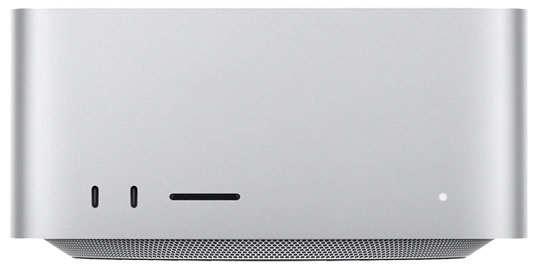
Photo Credit: Apple, Inc. (Mac Studio)
Traditionally, video processors that have "integrated" memory -- meaning that memory is shared with the system -- tend to be lower performance than those with "dedicated" memory reserved for the video processor, but benchmarks show that this is not really the case for the Mac Studio.
Mac Studio M1 Max/M1 Ultra 2022 Graphics Options
The original Mac Studio "M1 Max/M1 Ultra 2022" models -- the Mac Studio "M1 Max" 10 CPU/24 GPU and Mac Studio "M1 Ultra" 20 CPU/48 GPU -- were equipped by default with a 10-Core CPU and a 24-Core GPU and a 20-Core CPU and 48-Core GPU, respectively.
However, at the time of system purchase, the entry-level Mac Studio "M1 Max" 10 CPU/24 GPU model also could be custom configured with these CPU/GPU combos:
- M1 Max 10-Core CPU/32-Core GPU
- M1 Ultra 20-Core CPU/48-Core GPU
- M1 Ultra 20-Core CPU/64-Core GPU
The higher-end model -- the Mac Studio "M1 Ultra" 20 CPU/48 GPU -- also could be custom configured with a M1 Ultra 20-Core CPU and 64-Core GPU.
Mac Studio M2 Max/M2 Ultra 2023 Graphics Options
The subsequent Mac Studio "M2 Max/M2 Ultra 2023" models -- the Mac Studio "M2 Max" 12 CPU/30 GPU and Mac Studio "M2 Ultra" 24 CPU/60 GPU -- were configured by default with a 12-Core CPU and a 30-Core GPU and a 24-Core CPU and 60-Core GPU, respectively.
The entry-level Mac Studio "M2 Max" 12 CPU/30 GPU also could be custom configured with these CPU/GPU combos:
- M2 Max 12-Core CPU/38-Core GPU
- M2 Ultra 24-Core CPU/60-Core GPU
- M2 Ultra 24-Core CPU/76-Core GPU
The higher-end model -- the Mac Studio "M2 Ultra" 24 CPU/60 GPU -- also could be custom configured with an M2 Ultra 24-Core CPU and 76-Core GPU.
Mac Studio M3 Ultra/M4 Max 2025 Graphics Options
The Mac Studio "M3 Ultra/M4 Max 2025" models -- the Mac Studio "M3 Ultra" 28 CPU/60 GPU and Mac Studio "M4 Max" 14 CPU/32 GPU -- were configured by default with a 28-Core CPU and a 60-Core GPU and a 14-Core CPU and a 32-Core GPU, respectively.
The higher-end model -- the Mac Studio "M3 Ultra" 28 CPU/60 GPU -- also could be custom configured with an M3 Ultra 32-Core CPU and 80-Core GPU. The entry-level Mac Studio "M4 Max" 14 CPU/32 GPU also could be custom configured with an M4 Max 16-Core CPU and 40-Core GPU.
Mac Studio M5 Max/M5 Ultra 2026 Graphics Options
The current Mac Studio "M5 Max/M5 Ultra 2026" models -- the Mac Studio "M5 Max" 18 CPU/32 GPU and Mac Studio "M5 Ultra" 30 CPU/64 GPU -- are configured by default with an 18-Core CPU and a 32-Core GPU and a 30-Core CPU and a 64-Core GPU, respectively.
The entry-level model -- the Mac Studio "M5 Max" 18 CPU/32 GPU -- also can be custom configured with an 18-Core Apple M5 Max processor with a 40-Core GPU. The higher-end model -- the Mac Studio "M5 Ultra" 30 CPU/64 GPU -- also can be custom configured with a 36-Core Apple M5 Ultra processor with an 80-Core GPU.
It is not possible to upgrade the video processor in any Mac Studio after the initial system purchase.
What is the maximum resolution supported by the default configuration of the Mac Studio? How many displays can it support?
The maximum resolution and number of displays supported by each Mac Studio varies.
Regardless of the GPU, all "M1 Max", "M1 Ultra", and "M2 Max" Mac Studio models support "up to" five simultaneous displays -- four displays "up to" 6K resolution (6016x3384) at 60 Hz via USB-C and one display "up to" 4K (4096x2160) at 60 Hz via HDMI.
The "M2 Ultra" Mac Studio models support even more displays. These models support "up to" eight simultaneous displays at 4096x2160 (4K) resolution at 60 Hz, "up to" six simultaneous displays at 6016x3384 (6K) resolution at 60 Hz, or "up to" three simultaneous displays at 7680x4320 (8K).
The "M3 Ultra" Mac Studio supports "up to" eight simultaneous displays at 6016x3384 (6K) resolution at 60 Hz (or 4K resolution up to 144 Hz) or "up to" four simultaneous displays at 7680x4320 (8K) at 60 Hz (or 4K resolution up to 240 Hz).
The "M4 Max" Mac Studio supports "up to" five simultaneous displays -- four displays "up to" 6K resolution (6016x3384) at 60 Hz over Thunderbolt and one display "up to" 4K (4096x2160) at 60 Hz via HDMI or two displays "up to" 6K resolution (6016x3384) at 60 Hz over Thunderbolt and one display "up to" 8K resolution (7680x4320) at 60 Hz or "up to" 4K (4096x2160) resolution at "up to" 240 Hz over HDMI.
The "M5 Max" Mac Studio supports "up to" five external displays "over any combination of" the Thunderbolt 5 ports and the HDMI 2.1 port. This includes four displays up to a native resolution of 6K (6016x3384) at 60 Hz or 4K (4096x2160) at 165 Hz over Thunderbolt in addition to a fifth display with up to 5K (5120x2880) at 60Hz over HDMI.
Alternately, it can support two displays up to a native resolution of 8K at 60 Hz or 5K at 120 Hz or 4K at 240 Hz over Thunderbolt, plus a third display up to 5K at 60 Hz over HDMI. This Mac Studio supports "up to" four displays on a single Thunderbolt port as well as variable refresh rate (VRR), HDR, and multichannel audio.
The "M5 Ultra" Mac Studio supports "up to" eight external displays "over any combination of" the Thunderbolt 5 ports and the HDMI 2.1 port. This includes eight displays "up to" a native resolution of 6K (6016x3384) at 60 Hz or 4K (4096x2160) at 165 Hz.
Alternately, it can support "up to" four displays up to a native resolution of 8K at 60 Hz or 5K at 120 Hz or 4K at 240 Hz. This Mac Studio supports "up to" four displays on a single Thunderbolt port as well as variable refresh rate (VRR), HDR, and multichannel audio.
Does the Mac Studio support an eGPU?
An eGPU -- or external Graphics Processing Unit -- essentially is a graphics card in a box connected to a computer.
For any Intel-based Mac that has Thunderbolt 3 ports there are a variety of compatible eGPU models. However, these eGPUs explicitly are specified as not compatible with Apple Silicon-powered Macs like the Mac Studio at all.
However, in a glimmer of hope for those who like eGPUs, a small Hong Kong company released a third party eGPU driver called TinyGPU for Apple Silicon Macs that was approved by Apple. However, TinyGPU only works with LLM applications in a limited capacity; it does not support video or gaming, the more traditional uses for a eGPU.
Perhaps in the future, Apple will allow other third-parties to support an eGPU for other functionality, as well.
Permalink | Report an Error/Typo | Sign Up for Site Update Notices
Suggest a New Q&A | Sign Up for Bimonthly Site Update Notices
<< Mac Studio Q&A (Main) | All Mac Q&As
Established in 1996, EveryMac.com has been created by experts with decades of experience with Apple hardware. EveryMac.com includes, and always has included, original research incorporating detailed, hands-on inspection of packaging, computers, and devices as well as extensive real-world use. All information is provided in good faith, but no website or person is perfect. Accordingly, EveryMac.com is provided "as is" without warranty of any kind whatsoever. EveryMac.com, and the authors thereof, shall not be held responsible or liable, under any circumstances, for any damages resulting from the use or inability to use the information within. For complete disclaimer and copyright information please read and understand the Terms of Use and the Privacy Policy before using EveryMac.com. Copying, scraping, or use of any content without expressed permission is not allowed, although links to any page are welcomed and appreciated.