
Hosted by site sponsor WebMate.
Colorful Apple Silicon iMac Q&A
Published November 18, 2026
All Mac Q&As >> Colorful Apple Silicon iMac Q&A (Home)
To be notified of new Q&As, sign up for EveryMac.com's bimonthly email list.
What are all the differences between the iMac "2026 M6" iMac models and the iMac "2024 M4" models replaced? How much faster are the newer models?
There are two "2024 M4" iMac models -- the iMac "M4" 8 CPU/8 GPU/2 Ports 24" (2024) and iMac "M4" 10 CPU/10 GPU/4 Ports 24" (2024) -- and two "2026 M6" iMac models -- the iMac "M6" 10 CPU/10 GPU/2 Ports (2026) and iMac "M6" 12 CPU/12 GPU/4 Ports (2026) -- that replaced their predecessors.
With even a detailed review of these iMac models, it is impossible to tell them apart from appearance alone, but there are some differences. The quick answer is that the newer "2026 M6" iMac models have newer processors that are in the neighborhood of 20%-25% faster in single-core tasks and 35%-40% faster in multicore tasks. The newer models also have faster, more capable connectivity and different identifiers.
For some readers, that may be everything you need to know, but it also can be worthwhile to understand the similarities. An in-depth comparison still can be useful, accordingly.
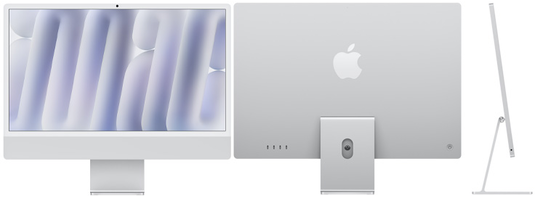
Photo Credit: Apple, Inc. (Higher-End iMac M4/M6 - Silver)
External Differences
The "2024 M4" iMac and "2026 M6" iMac models look identical externally -- and are offered in the exact same shades of silver, blue, purple, pink, orange, yellow, and green -- but there are differences quietly lurking underneath.
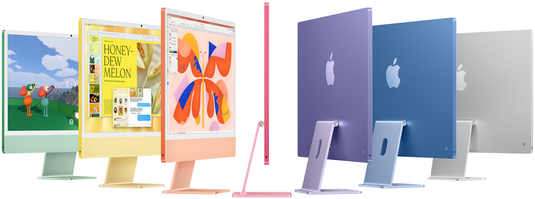
Photo Credit: Apple, Inc. (iMac M4/M6 - Color Options)
All of these models use the same wafer thin, all aluminum design with flat sides and a light gray frame around the display with a compact "chin" underneath. By default, these iMac models are mounted on an aluminum stand and are not VESA compliant, but all can, or could, be configured with a VESA mount option instead of the stand at the time of initial purchase at the same price points.
Despite the marketing as "24-Inch" 4.5K Retina displays, all of these iMac models actually have a 23.5-Inch LED-backlit widescreen TFT active matrix "Retina 4.5K" display with a native resolution of 4480x2520 at 218 ppi with "support for 1 billion colors," True Tone technology, wide color (P3), and brightness of 500 nits.
All of these models have a three-mic array, a six-speaker system, and a 12 megapixel "Center Stage" camera that automatically pans and zooms to keep subjects in frame. This camera also provides "Desk View" functionality that simulates an overhead camera to show both your face and a bird's eye view of your desk at the same time.
Connectivity Differences
Connectivity is a significant point of differentiation between the entry-level and higher-end models in each line and between lines, too. All have a 3.5-mm headphone jack conveniently located on the left side of the display, but the "2024 M4" iMac models support Wi-Fi 6E (802.11ax) and Bluetooth 5.3 whereas the "2026 M6" iMac models support the newer Wi-Fi 7 (802.11be) and Bluetooth 6 standards.
The entry-level models from both lines -- the iMac "M4" 8 CPU/8 GPU/2 Ports 24" (2024) and iMac "M6" 10 CPU/10 GPU/2 Ports (2026) -- have two USB-C shaped Thunderbolt / USB 4 ports. The high-end models from both lines -- the iMac "M4" 10 CPU/10 GPU/4 Ports 24" (2024) and iMac "M6" 12 CPU/12 GPU/4 Ports (2026) -- on the other hand, have four USB-C shaped "Thunderbolt 4 ports" that all support the faster Thunderbolt 4 / USB 4 standards.
The entry-level models from both lines also support a single 6K display whereas the high-end iMac "M4" 10 CPU/10 GPU/4 Ports 24" (2024) is advertised to support up to two 6K external displays at 60 Hz or one 8K external display at 60 Hz and the newer high-end iMac "M6" 12 CPU/12 GPU/4 Ports (2026) is advertised to support two 6K external displays at 60 Hz or two 4K at 165 Hz or one 8K external display at 60 Hz, one 5K at 120 Hz, or one 4K at 240 Hz.
The high-end models from both lines also can, or could, be custom configured with reduced glare "Nano-texture" glass for an extra US$200, as well, whereas entry-level models do not have the option.
The high-end models from each line additionally are bundled with a power supply that includes a Ethernet port -- Gigabit for the "2024 M4" and faster 2.5Gb for the "2026 M6" -- whereas the entry-level models lack an Ethernet port by default, but either could be custom configured with the same power supply as its higher-end contemporary at the time of initial purchase for an extra US$30.
Included Accessory Differences
The "2024 M4" and "2026 M6" iMac models include the same color-matched, USB-C equipped input accessories. There are differences between the entry-level and higher-end models from each line, though.
By default, all of these models ship with a wireless "Magic Mouse" with multi-touch surface support, but the entry-level models from both lines have a small aluminum wireless "Magic Keyboard" without "Touch ID" or a numeric keypad. The higher-end models have a small aluminum wireless "Magic Keyboard with Touch ID" , but still without a numeric keypad.
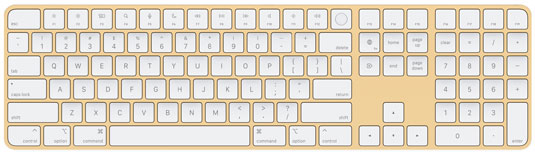
Photo Credit: Apple, Inc. (Magic Keyboard with Touch ID and Numeric Keypad)
At the time of purchase, both also can, or could, be custom configured with a "Magic Keyboard with Touch ID and Numeric Keypad" for an additional US$80 for the entry-level model and an additional US$30 for the higher-end model.
Both models also can be configured at the time of purchase to include a Magic Trackpad (which provides multi-touch input and Force Touch support) instead of the Magic Mouse for an extra US$50.
Identification Differences
The "2024 M4" and "2026 M6" iMac models are impossible to tell apart without specific identification details. As the site has done for decades now, EveryMac.com has hand documented these identifiers from the hardware itself.
Historically, Model Numbers -- located on the underside of the stand on each iMac and in software --commonly were shared across years, but the Model Numbers for the "2024 M4" iMac models actually are unique and this trend may continue for the "2026 M6" iMac models, also.
Typically, other identifiers commonly have been better for more specific identification, like the EMC Number and Model Identifier in software, and both of these are unique for the "2024 M4" iMac models, but the Model Identifier is shared by both "2026 M6" iMac models, so it is less useful than it is for earlier Apple Silicon iMac models.
These identifiers for all of these iMac models are:
24" iMac |
Subfamily |
Model |
EMC |
Model ID |
M4 2024 |
||||
M4 2024 |
||||
M6 2026 |
||||
M6 2026 |
Additionally, EveryMac.com's Ultimate Mac Lookup feature can uniquely identify all of these iMac models by other identifiers, as well.
Internal Differences
The "2024 M4" and "2026 M6" iMac models share a variety of internal components, but the later models have a faster CPU/GPU architecture in addition to faster storage.
The "2024 M4" iMac models use 4.4 GHz Apple M4 processors with either an 8 CPU/8 GPU core combo or a 10 CPU/10 GPU core combo, a single 16-core Neural Engine, and 120 GB/s of memory bandwidth.
The "2026 M6" iMac models, on the other hand, have newer and faster 4.7 GHz Apple M6 processors with either a 10 CPU/10 GPU core combo or a 12 CPU/12 GPU core combo, dual 16-core Neural Engines, and up to 170 GB/s of memory bandwidth.
In practice, Geekbench 7 benchmarks show that the entry-level "2026 M6" iMac -- the iMac "M6" 10 CPU/10 GPU/2 Ports (2026) -- is around 24% faster in single core tasks and 42% faster in multicore tasks than its predecessor and the high-end model -- the iMac "M6" 12 CPU/12 GPU/4 Ports (2026) -- is around 21% faster in single core tasks and 34% faster in multicore tasks than its predecessor.
All of these models have "unified" onboard memory and SSD storage that cannot be upgraded at all after the initial system purchase.
"2024 M4" & "2026 M6" iMac Comparison Charts
The major differences between the "2024 M4" and "2026 M6" iMac models -- processors/graphics processors, connectivity, and more -- are summarized below:
Entry-Level Models
 2024 2 Ports |
 2026 2 Ports |
|
|---|---|---|
| Architecture: | Apple M4 | Apple M6 |
| Clockspeed: | 4.4 GHz | 4.7 GHz |
| Processor Cores: | 8 Cores | 10 Cores |
| Graphics Cores: | 8 Cores | 10 Cores |
| Thunderbolt / USB 4: | 2 (USB-C) | 2 (USB-C) |
| Ethernet: | None* | None* |
| Webcam: | Center Stage | Center Stage |
| Nano Texture: | No | No |
| Ext. Displays: | 6K | 6K |
| Color Options: | Blue Green Pink Silver Yellow Orange Purple |
Blue Green Pink Silver Yellow Orange Purple |
| Std. Keyboard: | No Touch ID | No Touch ID |
| Std. RAM: | 16 GB | 16 GB |
| Max. RAM: | 24 GB** | 24 GB** |
| Std. Storage: | 256 GB | 256 GB |
| Max Storage: | 1 TB† | 1 TB† |
| Wi-Fi: | Wi-Fi 6 (802.11ax) | Wi-Fi 7 (802.11be) |
| Bluetooth: | 5.3 | 6 |
| Model Number: | A3247 | A3589 |
| Model ID: | Mac16,2 | Mac18,2 |
| EMC Number: | 8531 | 8974 |
| Original Price (US): | US$1299 | US$1499 |
| Original Price (CA): | C$1699 | C$2099 |
| Original Price (UK): | £1299 | £1499 |
| Original Price (AU): | A$1999 | A$2399 |
| Original Price (SG): | S$1799 | S$2099 |
High-End Models
2024 4 Ports |
2026 4 Ports |
|
|---|---|---|
| Architecture: | Apple M4 | Apple M6 |
| Clockspeed: | 4.4 GHz | 4.7 GHz |
| Processor Cores: | 10 Cores | 12 Cores |
| Graphics Cores: | 10 Cores | 12 Cores |
| Thunderbolt 4: | 4 (USB-C) | 4 (USB-C) |
| Ethernet: | Yes (Gb) | Yes (2.5Gb) |
| Webcam: | Center Stage | Center Stage |
| Nano Texture: | Optional | Optional |
| Ext. Displays: | 6K x2 | 6K x2 |
| Color Options: | Blue Green Pink Silver Yellow Orange Purple |
Blue Green Pink Silver Yellow Orange Purple |
| Std. Keyboard: | Touch ID | Touch ID |
| Std. RAM: | 16, 24 GB | 16 GB |
| Max. RAM: | 32 GB** | 32 GB** |
| Std. Storage: | 256 GB, 512 GB | 256 GB |
| Max Storage: | 2 TB† | 2 TB† |
| Wi-Fi: | Wi-Fi 6 (802.11ax) | Wi-Fi 7 (802.11be) |
| Bluetooth: | 5.3 | 6 |
| Model Number: | A3137 | A3590 |
| EMC Number: | 8532 | 8975 |
| Model ID: | Mac16,3 | Mac18,2 |
| Original Price (US): | US$1499 US$1699 US$1899 |
US$1699 |
| Original Price (CA): | C$1949 C$2199 C$2449 |
C$2299 |
| Original Price (UK): | £1499 £1699 £1899 |
£1699 |
| Original Price (AU): | A$2399 A$2699 A$2999 |
A$2699 |
| Original Price (SG): | S$2099 S$2399 S$2699 |
S$2399 |
* Ethernet is provided via the power supply. At the time of purchase, entry-level models can, or could, be custom configured to include the same Ethernet-equipped power supply as their corresponding high-end model for an extra US$30.
** At the time of purchase, all models can be custom configured to include more RAM than the default configuration. RAM cannot be upgraded subsequently.
† Both models can, or could, be custom configured with more storage at the time of system purchase at additional cost. Internal storage cannot be upgraded subsequently.
Ultimately, the "2026 M6" iMac models are a modest "speed bump" upgrade compared to their predecessors and pop out 20%-25% faster performance in single-core tasks and 35%-40% faster performance in multicore tasks alongside faster connectivity and higher price tags.
For those interested in saving money and do not mind sacrificing quite a bit of speed, the "2024 M4" iMac models remain well worth considering at discount prices on the used market.
New & Used iMac Purchase Options
There are many places to purchase a new or used iMac. However, buying from a quality company with an established track record in the Mac market will provide the best experience and save you money and time, too.
In the US, site sponsor Other World Computing sells used and refurb iMac models at bargain prices with free shipping, as well. On the other hand, if you need to sell an iMac, A+ BBB-rated Cash for Your Mac will buy your older iMac with an instant quote and prompt payment.
In the UK, site sponsor Hoxton Macs sells used iMac models with a one-year warranty and free next day delivery throughout the UK.
Permalink | Report an Error/Typo | Sign Up for Site Update Notices
Suggest a New Q&A | Sign Up for Bimonthly Site Update Notices
<< Colorful Apple Silicon iMac Q&A (Main) | All Mac Q&As
Established in 1996, EveryMac.com has been created by experts with decades of experience with Apple hardware. EveryMac.com includes, and always has included, original research incorporating detailed, hands-on inspection of packaging, computers, and devices as well as extensive real-world use. All information is provided in good faith, but no website or person is perfect. Accordingly, EveryMac.com is provided "as is" without warranty of any kind whatsoever. EveryMac.com, and the authors thereof, shall not be held responsible or liable, under any circumstances, for any damages resulting from the use or inability to use the information within. For complete disclaimer and copyright information please read and understand the Terms of Use and the Privacy Policy before using EveryMac.com. Copying, scraping, or use of any content without expressed permission is not allowed, although links to any page are welcomed and appreciated.