
Hosted by site sponsor WebMate.
iPhone Q&A
Published September 21, 2026
All Apple Q&As >> iPhone Q&A (Home)
To be notified of new Q&As, sign up for EveryMac.com's bimonthly email list.
What are all the differences between the iPhone 18 Pro and iPhone 18 Pro Max? What are the differences between these models and the iPhone 17 Pro/iPhone 17 Pro Max replaced? Are the newer models a significant upgrade?
There are sixteen specific iPhone 17 Pro, iPhone 17 Pro Max, iPhone 18 Pro, and iPhone 18 Pro Max models (four of each), but this EveryiPhone.com Q&A primarily covers the collective differences.
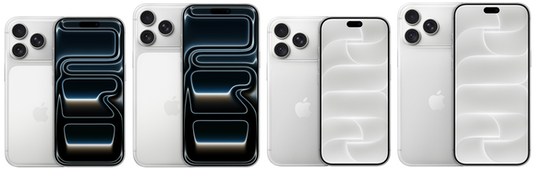
Photo Credit: Apple, Inc. (Left to Right: iPhone 17 Pro, 17 Pro Max, 18 Pro, 18 Pro Max)
iPhone 18 Pro & iPhone 18 Pro Max Differences
Just compared to one another, the iPhone 18 Pro and iPhone 18 Pro Max are quite similar, differing primarily by size, battery life, and price.
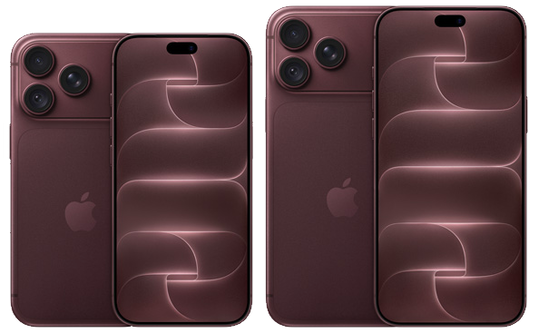
Photo Credit: Apple, Inc. (iPhone 18 Pro & iPhone 18 Pro Max - Burgundy)
The iPhone 18 Pro is smaller and US$100 cheaper than the iPhone 18 Pro Max; whereas the iPhone 18 Pro Max has even better battery life -- as long as 30 hours of "typical use" compared to 24 hours for the smaller model.
In the US, the iPhone 18 Pro Max also uses a slightly older Qualcomm modem compared to a newer Apple C2 modem in the smaller iPhone 18 Pro (and in all models internationally), but this is unlikely to be an important difference in practice.
The iPhone 18 Pro and iPhone 18 Pro Max also are quite similar to the iPhone 17 Pro and iPhone 17 Pro Max replaced; a detailed evaluation can be particularly useful accordingly. The differences may or may not be "significant" to you.
External Design & Functionality Differences
The iPhone 17 Pro/iPhone 17 Pro Max and iPhone 18 Pro/iPhone 18 Pro Max models all look nearly identical.
All are rounded rectangles with flat sides, have an aluminum frame, a glass front and back, and nearly edge-to-edge displays. All have the same physical buttons along the sides -- volume up/down and "Action" on the left, "Side" and "Camera Control" buttons on the right, and a USB-C connector on the bottom. All support "MagSafe" wireless charging on the back, also.
For durability, all of these models have a stronger "Ceramic Shield 2" on the front and the original "Ceramic Shield" on the back. All are waterproof to the IP68 standard (IEC standard 60529) for up to 30 minutes of water exposure to a depth of six meters. All have stereo speakers and a four-mic array, too.
However, just compared to one another (and ignoring many other models), with a close inspection, it is noticeable that the later models have a smaller "Dynamic Island" at the top of the display and a visible, physical aperture on the "Main" camera on the rear. The "Main" camera upgrade -- which allows for significantly better lighting and depth of field -- is the most substantial improvement of the iPhone 18 Pro/iPhone 18 Pro Max, no doubt.
Some models from both lines sold outside of North America additionally have a side-mounted access panel for physical nano SIM access (US models only support eSIM as do models sold in Canada, Mexico, Japan, Saudi Arabia, the UAE, and a handful of other countries).
Of course, the iPhone 17 Pro and iPhone 18 Pro are smaller than the iPhone 17 Pro Max and iPhone 18 Pro Max, but the later models are heavier than the earlier ones with the same dimensions:
 17 Pro |
17 Pro Max |
 18 Pro |
18 Pro Max |
|
| Material: | Aluminum/Glass | Aluminum/Glass | Aluminum/Glass | Aluminum/Glass |
| Rear: | 3 Cameras | 3 Cameras | 3 Cameras | 3 Cameras |
| Aperture: | Fixed | Fixed | Variable | Variable |
| Speakers: | Stereo | Stereo | Stereo | Stereo |
| Four Mics: | Yes | Yes | Yes | Yes |
| Height (In.): | 5.91 | 6.43 | 5.91 | 6.43 |
| Width (In.): | 2.83 | 3.07 | 2.83 | 3.07 |
| Depth (In.): | 0.34 | 0.34 | 0.34 | 0.34 |
| Weight (Oz.): | 7.27 | 8.22 | 7.44 | 8.78 |
Display Differences
The iPhone 17 Pro, iPhone 17 Pro Max, iPhone 18 Pro, iPhone 18 Pro Max all use the same high quality screens; "Super Retina XDR with ProMotion" displays with "Always On" capability, and an adaptive refresh rate up to 120 Hz.
The displays vary only by dimensions and resolution between the smaller and larger models from each series:
17 Pro |
17 Pro Max |
18 Pro |
18 Pro Max |
|
| Display Type: | ProMotion | ProMotion | ProMotion | ProMotion |
| Dimensions: | 6.3" | 6.9" | 6.3" | 6.9" |
| Resolution: | 2622x1206 | 2868x1320 | 2622x1206 | 2868x1320 |
| PPI: | 460 | 460 | 460 | 460 |
| Brightness: | 1000 nits | 1000 nits | 1000 nits | 1000 nits |
| HDR Max: | 1600 nits | 1600 nits | 1600 nits | 1600 nits |
| Outdoor Max: | 3000 nits | 3000 nits | 3000 nits | 3000 nits |
| Contrast: | 2 million:1 | 2 million:1 | 2 million:1 | 2 million:1 |
| Always On: | Yes | Yes | Yes | Yes |
Housing Color Differences
The case materials are the same, but some color options are different between the iPhone 17 Pro/iPhone 17 Pro Max and iPhone 18 Pro/iPhone 18 Pro Max lines.
The iPhone 17 Pro and iPhone 17 Pro Max (below) have three color options -- Silver, "Cosmic Orange", and "Deep Blue" (left to right).
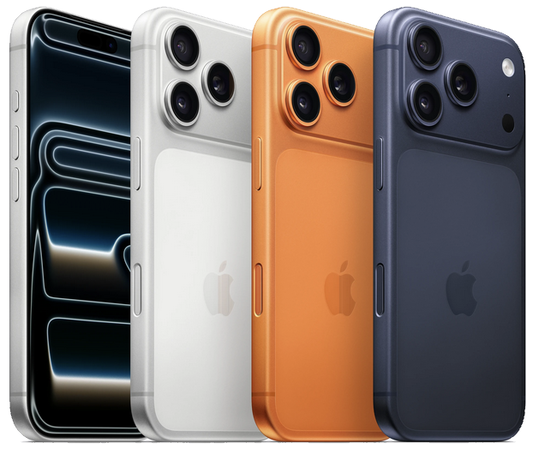
Photo Credit: Apple, Inc. (iPhone 17 Pro/iPhone 17 Pro Max Colors)
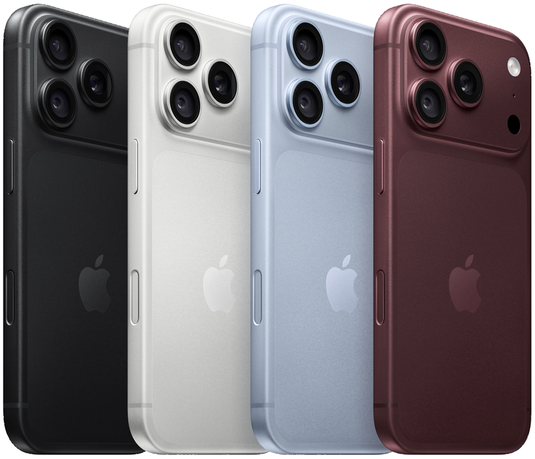
Photo Credit: Apple, Inc. (iPhone 18 Pro/iPhone 18 Pro Max Colors)
The iPhone 18 Pro and iPhone 18 Pro Max (above) have four color options -- Black, Silver, "Glacier", and "Burgundy" (left to right).
Camera Differences
The rear camera is a substantial upgrade in the newer iPhone 18 Pro/iPhone 18 Pro Max compared to their predecessors, although all support ProRAW photography and ProRes video recording. The front cameras are the same between lines.
Front Cameras
The front-facing camera on all four of these models -- which Apple has dubbed "Center Stage" -- support "Face ID" authentication, augmented reality (AR), still photos, and 4K video recording:
17 Pro |
17 Pro Max |
18 Pro |
18 Pro Max |
|
| Megapixels: | 18 MP | 18 MP | 18 MP | 18 MP |
| Aperture: | f/1.9 | f/1.9 | f/1.9 | f/1.9 |
| Video: | 4K | 4K | 4K | 4K |
| ProRAW: | Yes | Yes | Yes | Yes |
| ProRes: | Yes | Yes | Yes | Yes |
Rear Cameras
The iPhone 17 Pro/iPhone 17 Pro Max and iPhone 18 Pro/iPhone 18 Pro Max all have a "Pro Fusion camera system" that combines three lenses -- a 48 megapixel "Fusion Main", 48 megapixel "Fusion Ultra Wide", and 48 megapixel "Fusion Telephoto."
All of these models also support the Apple ProRAW photo format and ProRes video codec as well as other features geared toward professional photographers.
However, the 48 megapixel "Fusion Main" lens in the iPhone 18 Pro/iPhone 18 Pro Max models gains a significant upgrade; a physical variable aperture:
17 Pro |
17 Pro Max |
18 Pro |
18 Pro Max |
|
| Megapixels: | 48 MP x3 | 48 MP x3 | 48 MP x3 | 48 MP x3 |
| Fusion Main: | 24 mm f/1.78 |
24 mm f/1.78 |
24 mm Variable* |
24 mm Variable* |
| Ultra Wide: | 13 mm f/2.2 |
13 mm f/2.2 |
13 mm f/2.2 |
13 mm f/2.2 |
| Telephoto: | 100 mm f/2.8 |
100 mm f/2.8 |
100 mm f/2.8 |
100 mm f/2.8 |
| Digital Zoom: | 2x-40x† | 2x-40x† | 2x-40x† | 2x-40x† |
| ProRAW: | Yes | Yes | Yes | Yes |
| ProRes: | Yes | Yes | Yes | Yes |
* The variable aperture provides options of f/1.48, f/1.8, f/2.8, and f/4.0 by default. The iPhone 18 Pro and iPhone 18 Pro Max also have "pro controls" in software to manage the lens aperture, shutter speed, white balance, and other settings.
† By combining an image from multiple cameras, these iPhone models emulate an 8x optical zoom in, 2x optical zoom out, 16x optical zoom range, and digital zoom up to 40x. Apple advertises that the Fusion Main also "enables" 12 megapixel "optical-quality" 2x Telephoto (48 mm focal length) and the "Fusion Telephoto" also "enables" 12 megapixel "optical quality" 8x Telephoto (200 mm focal length, f/2.8 aperture).
Identification Differences
The iPhone 17 Pro, iPhone 17 Pro Max, iPhone 18 Pro, and iPhone 18 Pro Max are easy to mix up with any number of other iPhone models.
It is not possible to identify specific models within each line by appearance alone, either.
Accordingly, one relatively easy way to uniquely identify these models is by the Model Number listed on the cardboard shipping box, inside the USB-C port or SIM card tray, and within the iOS "Settings" app, among other places.
Consequently, for the purpose of this Q&A, it is sufficient to note that the following model numbers refer to these iPhone devices:
iPhone Model |
Model Number |
EveryiPhone.com's Ultimate iLookup feature also can precisely identify these iPhone models by Order Number (referred to as "Model" within the iOS "Settings" app under General > About), and other identifiers, as well.
Battery Life Differences
The iPhone 17 Pro, iPhone 17 Pro Max, iPhone 18 Pro, and iPhone 18 Pro Max all have superb battery life:
17 Pro |
17 Pro Max |
18 Pro |
18 Pro Max |
|
| Typical Use: | -- | -- | 24 Hours* | 30 Hours* |
| Local Video: | 33 Hours | 39 Hours | 36 Hours* | 45 Hours* |
| Streaming: | 30 Hours | 35 Hours | 33 Hours* | 40 Hours* |
* For the iPhone 18 Pro and iPhone 18 Pro Max, Apple introduced a new "typical use" metric for battery life and started differentiating between eSIM-only models and those with both a nano SIM and eSIM. eSIM only models have a bit larger battery; those with nano SIM and eSIM provide one hour less "typical use" and two hours less video playback and streaming video than Apple estimates for eSIM-only models.
Apple also no longer provides a battery life estimate for audio -- no doubt reflecting the reduced importance of these devices as portable music players since the iPod days -- but the largest iPhone 18 Pro Max provides the longest runtime of all these models regardless of the task performed.
Wireless Connectivity & Data Differences
Collectively, the iPhone 17 Pro, iPhone 17 Pro Max, iPhone 18 Pro, and iPhone 18 Pro Max provide the same general connectivity. For example, each provides 5G support, Gigabit LTE, Wi-Fi 7, Bluetooth 6, "second generation" Ultra Wideband, Thread networking, NFC capability, and more.
There are a few 5G and 4G LTE bands that are supported by some models and not others from both lines, though.
Most notably, for 5G, iPhone models from both lines sold in the United States support 5G mmWave bands n258 (26 GHz), n260 (39 GHz), n261 (28 GHz), but others do not.
Supported 4G and 5G bands vary accordingly:
iPhone Model |
Model No |
Additional 4G/5G |
iPhone 17 Pro (US) |
14 (700 PS) n14 (700 PS) n258 (26 GHz) |
|
iPhone 17 Pro (CA/MX/JP/SA) |
11 (1500 MHz) n14 (700 PS) |
|
|
53 (TD 2500) |
|
|
-- |
iPhone 17 Pro, iPhone 17 Pro Max, iPhone 18 Pro, and iPhone 18 Pro Max models sold in the United States, Canada, Mexico, Japan, Saudi Arabia, the UAE and a handful of other countries support dual eSIM and not a physical nano SIM. Models from both lines sold just about everywhere else in the would -- except for China -- support a single physical nano SIM and dual eSIM.
The Chinese models from both lines differ significantly, though. The Chinese iPhone 17 Pro and iPhone 17 Pro Max support dual physical nano SIM, but not eSIM. The newer iPhone 18 Pro and iPhone 18 Pro Max support both dual physical nano SIM and eSIM and can be used with either two nano SIM cards, one nano SIM and one eSIM, or two eSIM; the most versatile arrangement of any model.
Internal Differences
Although specific parts like batteries are different, these models have quite a bit in common internally. The newer iPhone 18 Pro and iPhone 18 Pro Max have faster CPUs with an extra GPU core as well as the option of 2 TB of storage for both devices:
17 Pro |
17 Pro Max |
18 Pro |
18 Pro Max |
|
| Clockspeed: | 4.25 GHz | 4.25 GHz | 4.9 GHz | 4.9 GHz |
| Processor: | A19 Pro | A19 Pro | A20 Pro | A20 Pro |
| CPU: | 6 Cores | 6 Cores | 6 Cores | 6 Cores |
| GPU: | 6 Cores | 6 Cores | 7 Cores | 7 Cores |
| RAM: | 12 GB | 12 GB | 12 GB | 12 GB |
| Storage: | 256/512/1 | 256/512/1/2 | 256/512/1/2 | 256/512/1/2 |
| USB-C: | USB 3 | USB 3 | USB 3 | USB 3 |
In terms of overall performance, the newer iPhone 18 Pro/iPhone 18 Pro Max are around 25% faster in single-core and 29% faster in multicore tasks than the iPhone 17 Pro/iPhone 17 Pro Max models replaced; an impressive jump in year-over-year performance.
iOS Support Differences
The iPhone 17 Pro and iPhone 17 Pro Max both originally shipped with iOS 26, whereas the newer iPhone 18 Pro and iPhone 18 Pro Max originally shipped with iOS 27.
However, both lines fully support iOS 27, including the "most powerful on-device model" of the Apple Intelligence (AI) feature.
iPhone 17 Pro/17 Pro Max; iPhone 18 Pro/18 Pro Max Comparison Chart
These differences as well as other details and pricing information is summarized below:
17 Pro |
17 Pro Max |
18 Pro |
18 Pro Max |
|
| Introduced: | Sep 2025 | Sep 2025 | Sep 2026 | Sep 2026 |
| Discontinued: | Sep 2026 | Sep 2026 | Current | Current |
| Processor: | A19 Pro | A19 Pro | A20 Pro | A20 Pro |
| GPU Cores: | 6 | 6 | 7 | 7 |
| RAM: | 12 GB | 12 GB | 12 GB | 12 GB |
| Storage: | 256/512/1 | 256/512/1/2 | 256/512/1/2 | 256/512/1/2 |
| Battery Life: | 30-33 Hours | 35-39 Hours | 33-36 Hours | 40-45 Hours |
| Display Size: | 6.3" | 6.9" | 6.3" | 6.9" |
| Resolution: | 2622x1206 | 2868x1320 | 2622x1206 | 2868x1320 |
| Display Type: | ProMotion | ProMotion | ProMotion | ProMotion |
| Always On: | Yes | Yes | Yes | Yes |
| Front Camera: | 18 MP | 18 MP | 18 MP | 18 MP |
| Rear Camera: | 48 MP x2 | 48 MP x3 | 48 MP x3 | 48 MP x3 |
| Aperture: | Fixed | Fixed | Variable | Variable |
| ProRes: | Yes | Yes | Yes | Yes |
| Material: | Al/Glass | Al/Glass | Al/Glass | Al/Glass |
| 4 Mics: | Yes | Yes | Yes | Yes |
| Speakers: | Stereo | Stereo | Stereo | Stereo |
| LiDAR: | Yes | Yes | Yes | Yes |
| Wi-Fi: | 7 | 7 | 7 | 7 |
| Thread: | Yes | Yes | Yes | Yes |
| USB-C: | USB 3 | USB 3 | USB 3 | USB 3 |
| Colors: | 3 Colors | 3 Colors | 4 Colors | 4 Colors |
| SIM Card: | Nano/eSIM | Nano/eSIM | Nano/eSIM | Nano/eSIM |
| Orig. iOS: | iOS 26 | iOS 26 | iOS 27 | iOS 27 |
| Max. iOS: | iOS 27 | iOS 27 | iOS 27 | iOS 27 |
| Apple AI: | Yes | Yes | Yes | Yes |
| Orig. USD: | US$1099 US$1299 US$1499 |
US$1199 US$1399 US$1599 US$1999 |
US$1199 US$1399 US$1799 US$2399 |
US$1299 US$1499 US$1899 US$2499 |
| Orig. GBP: | £1099 £1299 £1499 |
£1199 £1399 £1599 £1999 |
£1199 £1399 £1799 £2399 |
£1299 £1499 £1899 £2499 |
| Orig. CAD: | C$1599 C$1899 C$2199 |
C$1749 C$2049 C$2349 C$2949 |
C$1749 C$2049 C$2649 C$3549 |
C$1849 C$2199 C$2799 C$3699 |
| Orig. AUD: | A$1999 A$2399 A$2799 |
A$2199 A$2599 A$2999 A$3799 |
A$2099 A$2499 A$3299 A$4499 |
A$2299 A$2699 A$3499 A$4699 |
| Orig. JPY: | ¥179,800 ¥214,800 ¥249,800 |
¥194,800 ¥229,800 ¥264,800 ¥329,800 |
¥219,800 ¥254,800 ¥324,800 ¥429,800 |
¥239,800 ¥274,800 ¥344,800 ¥429,800 |
| Orig. CNY: | RMB 8,999 RMB 10,999 RMB 12,999 |
RMB 9,999 RMB 11,999 RMB 13,999 RMB 17,999 |
RMB 9,999 RMB 11,999 RMB 15,499 RMB 20,499 |
RMB 10,999 RMB 12,999 RMB 16,499 RMB 21,499 |
These original prices are for devices unlocked and paid in full upfront. Carrier subsidized options, leases, and trade-in discounts also are available.
For pricing in dozens of countries, see the "Global Prices" on the specs page for each iPhone as well as the "By Global Original Prices" section of EveryiPhone.com.
So, which is for me? Should I buy a newer iPhone 18 Pro or iPhone 18 Pro Max or an older iPhone 17 Pro or iPhone 17 Pro Max?
Compared only to one another, and ignoring other iPhone models, the newer iPhone 18 Pro and iPhone 18 Pro Max provide (1) a substantially better rear camera, (2) about 25%-29% faster performance, and (3) better battery life. The smaller iPhone 18 Pro model also gains (4) the option of higher storage capacity.
These are significant improvements, but the iPhone 17 Pro and iPhone 17 Pro Max are available at lower prices on the used market and remain a particularly good value as a result.
Of course, for those on a budget, any number of older iPhone models also are well worth considering to save more money, too.
Site sponsor Other World Computing sells used and refurbished iPhone models with free shipping. If you need to sell an iPhone, A+ BBB-rated Cash for Your Mac and GoRoostr will buy your older iPhone with an instant quote and prompt payment.
Please also see EveryiPhone.com's Ultimate iComparison feature to dynamically compare any iPhone model to any other iPod, iPhone, or iPad.
Permalink | Report an Error/Typo | Sign Up for Site Update Notices
<< iPhone Q&A (Main) | All Apple Q&As
Established in 1996, EveryMac.com has been created by experts with decades of experience with Apple hardware. EveryMac.com includes, and always has included, original research incorporating detailed, hands-on inspection of packaging, computers, and devices as well as extensive real-world use. All information is provided in good faith, but no website or person is perfect. Accordingly, EveryMac.com is provided "as is" without warranty of any kind whatsoever. EveryMac.com, and the authors thereof, shall not be held responsible or liable, under any circumstances, for any damages resulting from the use or inability to use the information within. For complete disclaimer and copyright information please read and understand the Terms of Use and the Privacy Policy before using EveryMac.com. Copying, scraping, or use of any content without expressed permission is not allowed, although links to any page are welcomed and appreciated.