
Hosted by site sponsor WebMate.
Apple Silicon Mac mini Q&A
Published October 9, 2026
All Mac Q&As >> Apple Silicon Mac mini Q&A (Home)
To be notified of new Q&As, sign up for EveryMac.com's bimonthly email list.
What are all the differences between the ""M5 Pro" and "M6" Mac mini models? Which is actually faster?
There are two standard "2026" Mac mini models -- the Mac mini "M5 Pro" 15 CPU/16 GPU 2026 and Mac mini "M6" 12 CPU/12 GPU 2026 -- as well as the configure-to-order Mac mini "M5 Pro" 18 CPU/20 GPU 2026 equipped with more CPU and GPU cores.
Somewhat counterintuitively, the entry-level Mac mini model is the higher numbered "M6" whereas the more expensive, largely more capable Mac mini models use the earlier generation "M5 Pro" processor.
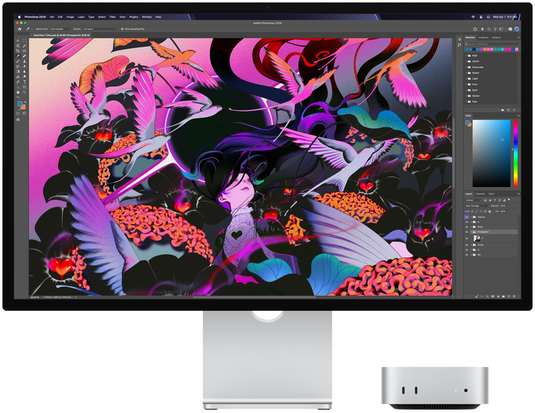
Photo Credit: Apple, Inc. (Mac mini "2026 M5 Pro/M6")
Although the "2026 M5 Pro/M6" Mac mini models look the same, there actually are a number of notable external and internal differences. It is important to understand these differences in order to select the best option for you.
External Differences
The "2026 M5 Pro/M6" Mac mini models each use essentially the same tiny "cuboid" aluminum case design that is 5.0 inches across and deep and 2.0 inches tall. The "M5 Pro" models are slightly heavier (0.1 of a pound), but you would have to be awfully perceptive to notice. It is not particularly important for a desktop Mac, either.
All of these models are effectively sealed and disposable -- the processor, graphics processor, RAM, and storage are not upgradable.
Connectivity Differences
Connectivity is an important difference between the "2026 M5 Pro" and "2026 M6" Mac mini models, although it is subtle and not visually apparent, either.
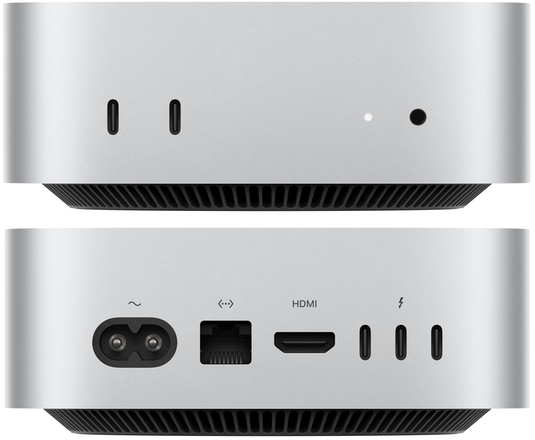
Photo Credit: Apple, Inc. (Mac mini M5 Pro/M6: Top - Front, Bottom - Back)
On the front, each of these models have two front-mounted USB-C ports with support for USB 3 (up to 10 Gb/s) and a 3.5 mm headphone jack. On the back, all have default 2.5Gb Ethernet (with 10-Gigabit Ethernet available as a custom configuration option) and an HDMI port. They also all support 802.11be Wi-Fi 7 and Bluetooth 6.
However, the entry-level "2026 M6" Mac mini -- the Mac mini "M6" 12 CPU/12 GPU 2026 -- has three Thunderbolt 4 ports (up to 40 Gb/s) whereas the higher-end "2026 M5 Pro" models have three Thunderbolt 5 ports (up to 120 Gb/s). These ports look the same and are not labeled differently, but Thunderbolt 5 is much faster.
In addition to support for the faster Thunderbolt 5 standard, display support is superior on the higher-end Mac mini models, as well. All support as many as three displays, but the entry-level "M6" Mac mini only supports two 6K displays and one 5K display or one 8K display and one 5K (60 Hz) display. The higher-end "M5 Pro" models, on the other hand, support as many as three 6K displays or one 8K display and one 5K (120 Hz) display.
Identification Differences
As diligently hand documented by EveryMac.com, the "2026 M5 Pro" Mac mini and "2026 M6" Mac mini have different Model Numbers and EMC Numbers externally on the underside.
At least for now, these identifiers are unique to both lines and suitable for specific identification, but the Model Identifier in software also is a reliable way to differentiate between these systems and others for the long-term:
| Mac mini | Model No. | EMC No. | Model ID |
| 2026 M5 Pro | A3535 | 9034 | Mac17,16 |
| 2026 M6 | A3534 | 9032 | Mac18,5 |
Additionally, EveryMac.com's Ultimate Mac Lookup feature can uniquely identify all of these Mac mini models by other identifiers.
More information about specific identifiers is provided in EveryMac.com's extensive Mac Identification section.
Internal Differences
Internally, the "2026 M5 Pro" and "2026 M6" Mac mini models have major differences.
The entry-level "M6" model -- the Mac mini "M6" 12 CPU/12 GPU 2026 -- has an Apple "M6" SoC with a 4.8 GHz 12-core CPU/12-Core GPU, 16 GB or 24 GB of "unified" memory, and either 256 GB or 512 GB of integrated storage. At the time of initial system purchase, this model can be custom configured with 32 GB of RAM and 1 TB or 2 TB of storage at additional cost, as well.
The higher-end "M5 Pro" models -- Mac mini "M5 Pro" 15 CPU/16 GPU 2026 and Mac mini "M5 Pro" 18 CPU/20 GPU 2026 -- have an Apple "M5 Pro" SoC with a slower 4.6 GHz clockspeed but more CPU and GPU cores, 24 GB of "unified" memory and 512 GB of integrated storage. At the time of initial system purchase, these models can be custom configured with 48 or 64 GB GB of RAM and 1 TB, 2 TB, 4 TB, or 8 TB of storage.
Performance Differences
In terms of performance, the "2026" Mac mini models are rather unusual. The high-end Mac mini "M5 Pro" has more CPU and GPU cores than the entry-level Mac mini "M6" but also a 4% slower clockspeed.
Overall, as benchmarked by Geekbench 7, the entry-level Mac mini actually is around 9% faster than the higher-end models in single core tasks. In multicore tasks, though, the higher-end "M5 Pro" models smoke the entry-level "M6" with scores around 36% and 52% faster, respectively.
Comparison Chart
The specific differences between processors, architectures, configurations, connectivity, identifiers, and prices for the "2026 M5 Pro" and "2026 M6" Mac mini models are summarized below:
 "2026 M6" |
"2026 M5 Pro" |
|
|---|---|---|
| Processor Type: | Apple M6 | Apple M5 Pro |
| Processor Cores: | 12 | 15, 18 |
| Graphics Cores: | 12 | 16, 20 |
| Std. RAM: | 16 GB, 24 GB | 24 GB |
| Max. RAM: | 32 GB* | 64 GB* |
| Std. Storage: | 256, 512 GB | 512 GB |
| Max. Storage: | 2 TB† | 8 TB† |
| Ext. Displays: | 2 6K; 1 5K | 3 6K |
| 8K Support: | Yes | Yes |
| Thunderbolt: | 3 (4) | 3 (5) |
| USB-C: | 2 | 2 |
| Order Number: | MHQK4LL/A MHQL4LL/A MHQM4LL/A |
MHQN4LL/A |
| Model Number: | A3534 | A3535 |
| EMC Number: | 9032 | 9034 |
| Model Identifier: | Mac18,5 | Mac17,16 |
| Intro Price (US): | US$899 US$1099 US$1299 |
US$1699 US$1899 |
| Intro Price (CA): | C$1249 C$1549 C$1849 |
C$2399 C$2699 |
| Intro Price (UK): | £899 £1099 £1299 |
£1699 £1899 |
| Intro Price (AU): | A$1449 A$1749 A$2049 |
A$2699 A$2999 |
| Intro Price (SG): | S$1299 S$1599 S$1899 |
S$2499 S$2799 |
* At the time of initial system purchase, the "2026 M6" Mac mini can be custom configured with 32 GB of RAM. The "2026 M5 Pro" can be custom configured with 48 GB or 64 GB of RAM. The RAM cannot be upgraded later at all.
† At the time of initial system purchase, the "2026 M6" Mac mini can be custom configured with 1 TB or 2 TB of storage. The "2026 M5 Pro" can be custom configured with 1 TB, 2 TB, 4 TB, or 8 TB of storage.
For pricing information in dozens of other countries, refer to EveryMac.com's Global Original Prices section.
So, which is best for my needs?
Ultimately, the entry-level "2026 M6" Mac mini is the best option if you insist on a new Mac desktop and you want the cheapest option. If you just want the cheapest new Mac, the MacBook Neo notebook is even cheaper and comes with a "free" integrated display, keyboard, and trackpad.
Of course, used Mac mini models also will be cheaper than new ones, but just among the 2026 Mac mini, the entry-level "2026 M6" Mac mini is more than fast enough for basic productivity and web use these days and it even is 9% faster than the higher-end models in single core tasks.
However, compared to the entry-level option, the higher-end "2026 M5 Pro" Mac mini models are (1) around 36% faster and 52% faster in multicore tasks, (2) have faster Thunderbolt ports, and (3) have superior external display support. At additional cost, they also can be configured with more RAM and storage. For those who can put the extra performance and better connectivity to good use, the extra cost of a higher-end model could be well worth it.
In the US, site sponsor Other World Computing sells used and refurb Mac mini models at bargain prices with free shipping, as well. If you need to sell a Mac mini, A+ BBB-rated Cash for Your Mac will buy your older Mac mini with an instant quote and prompt payment.
In the UK, site sponsor Hoxton Macs sells used Mac mini models with a one-year warranty and free next day delivery throughout the UK.
Please refer to EveryMac.com's Ultimate Mac Comparison feature to dynamically compare any Mac mini model to any other Mac.
Permalink | Report an Error/Typo | Sign Up for Site Update Notices
Suggest a New Q&A | Sign Up for Bimonthly Site Update Notices
<< Apple Silicon Mac mini Q&A (Main) | All Mac Q&As
Established in 1996, EveryMac.com has been created by experts with decades of experience with Apple hardware. EveryMac.com includes, and always has included, original research incorporating detailed, hands-on inspection of packaging, computers, and devices as well as extensive real-world use. All information is provided in good faith, but no website or person is perfect. Accordingly, EveryMac.com is provided "as is" without warranty of any kind whatsoever. EveryMac.com, and the authors thereof, shall not be held responsible or liable, under any circumstances, for any damages resulting from the use or inability to use the information within. For complete disclaimer and copyright information please read and understand the Terms of Use and the Privacy Policy before using EveryMac.com. Copying, scraping, or use of any content without expressed permission is not allowed, although links to any page are welcomed and appreciated.